

Why Tai Seng Is a Food-Manufacturing Cluster
Tai Seng has matured into one of central Singapore's most accessible food-production hubs. Here's what makes the location work for food businesses.
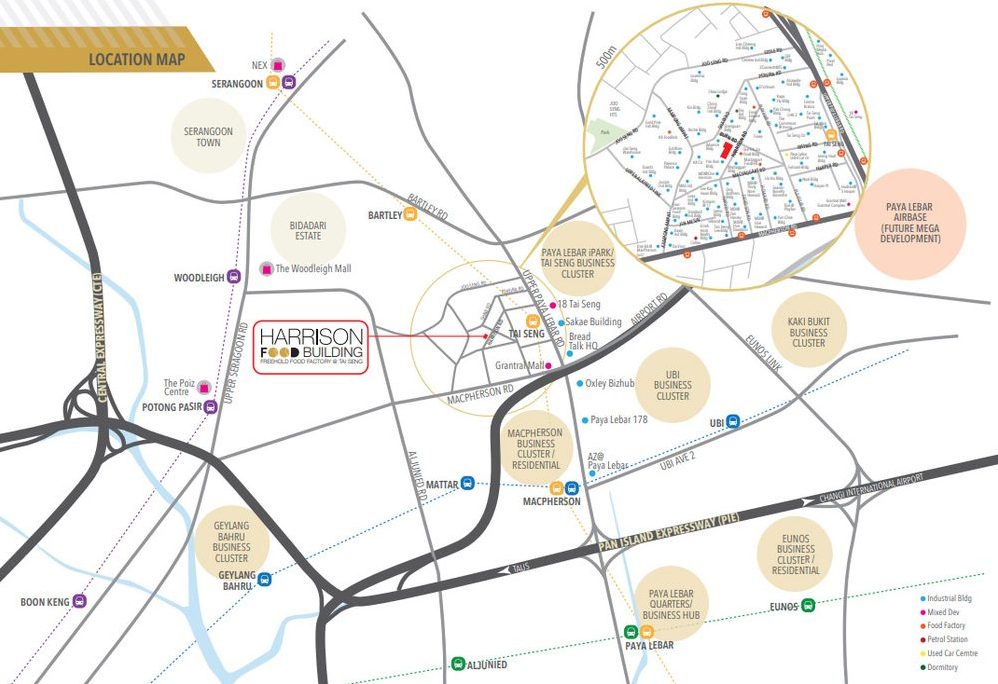
Location decides a food factory's logistics cost and staffing reach for the life of the operation. Tai Seng sits in a rare sweet spot: central, well-connected and surrounded by established industrial estates.
Connectivity that cuts logistics cost
Tai Seng MRT (CC11) on the Circle Line is about a five-minute walk, reaching Bartley, Serangoon, Paya Lebar and MacPherson without a transfer. By road, the PIE and CTE are roughly eight minutes away and the KPE sits next door — useful for cold-chain and ready-to-eat distribution where delivery windows are tight.
An established food and light-industrial belt
The cluster neighbours Paya Lebar iPark, Bartley Industrial, Kaki Bukit and the MacPherson belt — home to hundreds of central kitchens, packers and ready-to-eat producers. Being inside an existing ecosystem helps with suppliers, talent and SFA-licensed neighbours.
A medium-term tailwind
The Paya Lebar Airbase relocation by 2030 is set to lift the area's height cap and unlock new housing nearby — a structural positive for central-region industrial value. For a project-level view of all this, see Harrison Food Building and the detailed location analysis.